



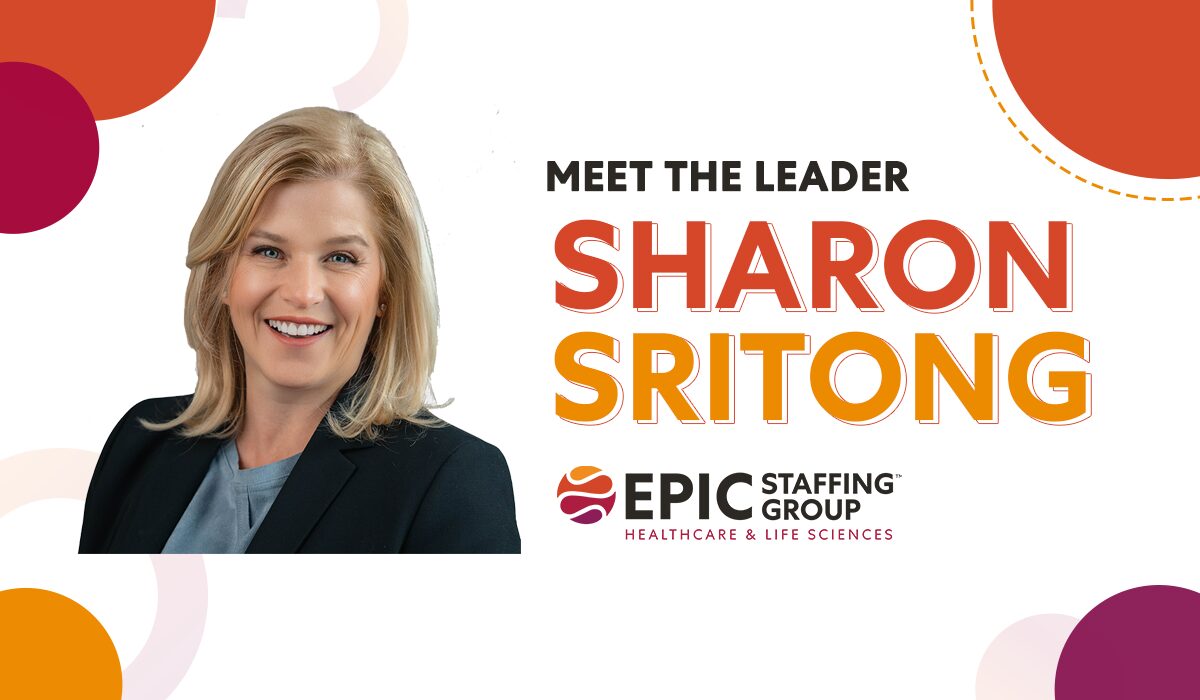
In today’s healthcare environment, financial leadership is no longer confined to balance sheets and budget cycles. It sits at the center of operational strategy, workforce planning, and patient care outcomes. In this installment of Epic Staffing Group’s Meet the Leader series, Chief Financial Officer Sharon Sritong shares how healthcare CFOs can approach uncertainty, control labor costs, and rethink staffing models without compromising care quality.
Sharon brings a cross-industry perspective shaped by experience in multiple sectors and a deep belief that financial performance is always tied to operational reality. That lens is especially relevant as hospitals continue to navigate volatility in 2026.
From Numbers to Narrative: A CFO’s Role in Healthcare
Sharon’s path to healthcare wasn’t linear. Originally from Australia, she built her career intentionally across a range of roles and industries, gaining exposure to different financial models, business structures, and operational environments. She began in audit and tax, building a strong technical foundation before moving into internal finance roles where she could have a more direct impact. From there, she led global tax and compliance functions and took on broader financial leadership responsibilities, including supporting international expansion and stepping into a North America CFO role.
That breadth shaped a core philosophy that defines her leadership today: numbers tell a story, but only if you understand the operations behind them. By working across sectors including logistics, SaaS, and professional services, she developed the ability to step into unfamiliar environments and quickly identify the underlying drivers of performance. After years of leading through growth and acquisitions, she transitioned into private equity-backed organizations, where financial discipline and operational execution are closely tied.
That mindset ultimately led her to Epic Staffing Group. Coming from a strong background in B2B and professional services, she was drawn to the opportunity to learn a new industry while applying her expertise in a more complex, high-impact environment. Epic Staffing Group’s structure, with its multiple specialized business units, offered a unique opportunity to engage with diverse parts of the healthcare ecosystem. The ability to continuously learn while contributing at a strategic level made the role particularly compelling.
For healthcare CFOs, this perspective is especially relevant. Financial performance is not just a result of reimbursement rates or cost controls. It’s driven by staffing decisions, patient volumes, clinical efficiency, and access to specialized talent. Entering healthcare without prior experience, she leaned into curiosity, asking deeper questions about how operations translate into financial outcomes, a mindset she continues to apply today.
The Defining Pressure of 2026: Uncertainty
When asked about the biggest financial pressure hospitals face today, Sharon points to one factor above all others: uncertainty.
Policy shifts, evolving reimbursement models, and broader economic factors are making long-term planning increasingly difficult. Many hospitals are operating on shortened planning cycles, often making decisions one quarter or even one month at a time.
This environment changes how CFOs must think about workforce strategy. As Sharon explains, “the uncertainty of policy direction and what your budget might look like as a result makes it difficult to make permanent decisions.” She adds that this is exactly where flexibility becomes critical, noting that with the right staffing partner, “you can control the spend in small increments… you can make a decision for your next quarter, you can make a decision for your next week.”
The challenge, then, is not just controlling costs but maintaining flexibility without sacrificing care delivery.
This is where Epic Staffing Group’s model aligns closely with CFO priorities. By enabling hospitals to scale staffing up or down based on real-time needs, organizations can better manage financial exposure while maintaining access to critical talent.
The Hidden Cost of the Wrong Tradeoffs
Cost containment remains a top priority, but Sharon cautions against a common mistake: over-relying on existing staff to absorb demand.
While reducing external spend may appear efficient in the short term, the long-term impact can be significant. Burnout, turnover, and decreased care quality create downstream financial and operational consequences that are often far more costly.
For CFOs, this reframes the conversation. The goal is not simply to reduce labor costs, but to optimize them in a way that protects both staff sustainability and patient outcomes.
Epic Staffing Group’s approach directly addresses this challenge by offering flexible staffing solutions across multiple specialties. Instead of forcing hospitals into rigid models, the organization works with clients to design staffing strategies that align with both financial constraints and clinical realities.
A Structurally Different Staffing Model
One of the key differentiators Sharon highlights is the breadth of Epic Staffing Group’s delivery model.
Hospitals are not dealing with a single type of workforce need. They may require short-term locum tenens coverage, longer-term travel assignments, permanent placements, or even full-service line support in highly specialized areas like cardiovascular care. In some cases, international staffing solutions can provide longer-term stability at a competitive cost while maintaining high standards of care.
Rather than offering a one-size-fits-all solution, Epic Staffing Group brings together multiple service lines under one umbrella. This allows CFOs to approach workforce planning with greater precision.
From a financial perspective, this creates three key advantages:
- Cost variability: Hospitals can align spend with actual demand rather than fixed headcount
- Risk mitigation: Reduced exposure to long-term commitments in uncertain environments
- Access to specialized talent: Nationwide and global networks ensure coverage across hard-to-fill roles
This multi-channel model stands in contrast to competitors that focus narrowly on one staffing type or operate within limited geographic or specialty constraints.
What Predictability Actually Looks Like
Predictability in staffing does not come from locking in fixed costs. According to Sharon, it comes from understanding your baseline and building flexibility around it.
She recommends that CFOs start by defining a core staffing level based on consistent patient volumes and procedural demand. As Sharon explains, “you want a base level of care, base level of staffing that allows you to fulfil your obligations as a facility.” From there, the focus shifts to variability: “it is looking at those peaks and troughs to say how do I look at that and how do I supplement it with contingent labor as a result.”
This approach mirrors financial planning principles used in other industries, where variable resources are deployed to handle demand fluctuations without overextending fixed costs.
Epic Staffing Group supports this model by providing continuous access to talent across specialties. Instead of forcing hospitals to invest time and resources into recruitment, they can rely on a partner that is already engaged in the market, maintaining relationships with clinicians and accelerating time to placement.
Financial Levers That Matter Right Now
In the current environment, Sharon advises healthcare leaders to focus on two primary financial levers:
1. Strategic Cost Control
Labor remains one of the largest expense categories for hospitals. While certain costs, such as staffing ratios, cannot be reduced, other expenditures can be delayed or optimized. Capital investments, equipment purchases, and non-essential spending should be evaluated carefully in light of ongoing uncertainty.
2. Cash Flow Management
Maintaining liquidity is critical. This includes renegotiating vendor terms, optimizing payment cycles, and ensuring that cash is available to support essential operations, including staffing.
Workforce flexibility plays a role in both areas. By avoiding overcommitment to fixed labor costs, hospitals can preserve cash while maintaining the ability to respond to changing demand.
What Healthcare CFOs Should Look for in a Staffing Partner
Beyond rates, Sharon emphasizes three factors that should guide partner selection:
Transparency
Healthcare CFOs need a clear understanding of what they are paying for. This includes all components of staffing costs, from overtime to housing and additional fees.
Quality and Access to Talent
The strength of a staffing partner lies in its network and its ability to consistently deliver qualified clinicians. This requires ongoing engagement with the market and efficient processes for sourcing and placement.
True Partnership
The most effective staffing relationships function as extensions of the hospital’s internal team. This means alignment on goals, clear communication, and a shared commitment to both financial and clinical outcomes.
Epic Staffing Group’s model reflects these priorities through high-touch account management, deep specialty expertise, and a relationship-driven approach that prioritizes long-term client success.
Looking Ahead: What Will Separate High-Performing Healthcare Organizations
As the market continues to evolve, Sharon believes that successful healthcare organizations will be defined by their ability to balance financial discipline with patient care excellence. As she puts it, “I think the wrong decision is putting your patients at risk. And that means overburdening current staff.”
This underscores a central truth in healthcare operations: workforce stability and patient outcomes are deeply interconnected. As Sharon emphasizes, “you need to make sure your base employee is happy.” When staff are supported and not overburdened, they are better able to deliver the high-quality care that drives both patient trust and organizational sustainability.
This requires more than cost control. It requires thoughtful workforce planning, investment in staff well-being, and access to the right talent at the right time.
Organizations that rely solely on rigid staffing models or short-term cost-cutting measures will struggle to keep pace. Those that embrace flexibility, leverage data, and partner with experienced staffing organizations will be better positioned to navigate ongoing uncertainty.
Rethinking Healthcare Finance with Epic Staffing Group
Healthcare CFOs are being asked to manage rising uncertainty while still protecting care quality and financial stability. As Sharon Sritong highlights, the answer is not rigid cost-cutting but building flexibility into workforce strategy through better use of contingent and specialized talent. Epic Staffing Group supports this shift by helping organizations align staffing decisions with real-time demand, financial constraints, and clinical needs. In a volatile 2026 environment, that level of adaptability is becoming a defining factor in long-term performance.
Epic Staffing Group is a diversified national provider of staffing services to the healthcare and biopharmaceutical industries. We focus on outsourced placement of talented and in-demand individuals in Life Sciences, Nursing, Allied Health, Children’s Physical & Behavioral Therapy, Cardiac & Cancer Treatment, Diagnostics and Imaging, Locum Tenens Surgical Services, and Interim Leadership. Check out our blog to learn more about the amazing leadership behind Epic’s continued success.

